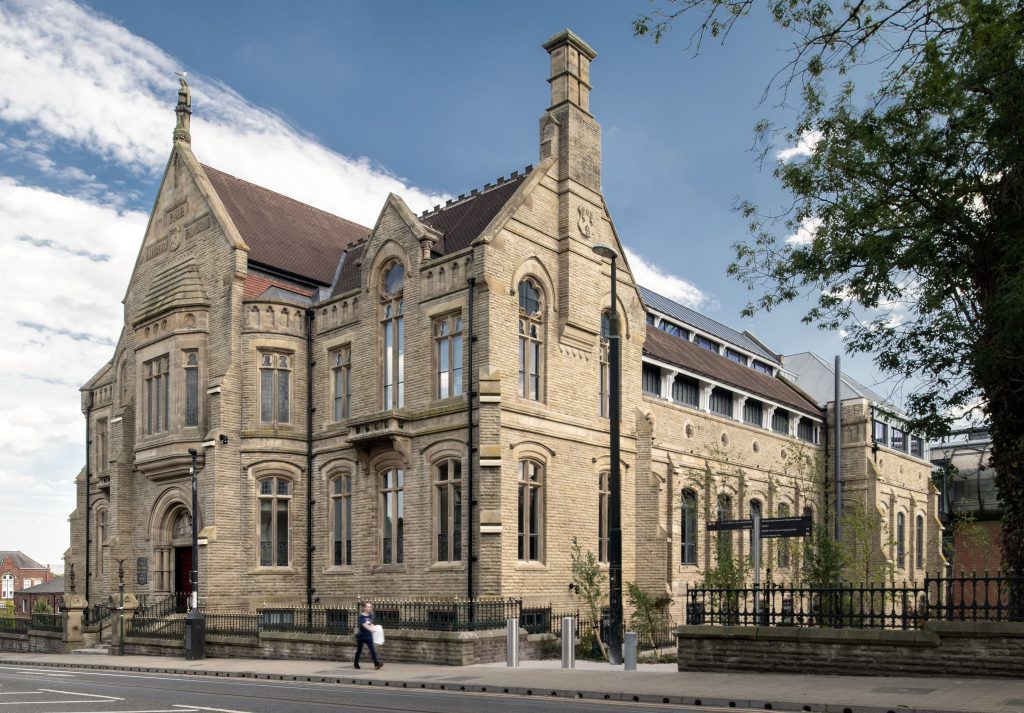

Old Library, Oldham
Our team was appointed by Tilbury Douglas Engineering to support Oldham Councils sustainability ambitions by undertaking a Low Zero Carbon (LZC) assessment for the refurbishment of the Grade II Listed Oldham Heritage Centre, originally constructed in 1883.
The redevelopment transformed the former library into a vibrant multi-purpose community heritage and administrative hub, featuring exhibition galleries, conference and meeting rooms, a new council chamber, administrative offices, and performance studios.Our team carried out the assessment in collaboration with the MEP design team, using IES-VE dynamic simulation software to evaluate the building’s baseline energy performance and model the impact of various low and zero carbon technologies. The study considered the unique constraints of a heritage building, ensuring that energy efficiency improvements aligned with strict conservation requirements.
Our sustainability team also reduced the need for modern interventions (that would have impacted on the buildings aesthetic) in the form of mechanical ventilation and cooling throughout the building by maximising the use of natural ventilation. New actuated openings and actuated roof lights were installed and their effectiveness was quantified and verified utilising IEs-VE software to undertake CFD dynamic simulations of air flows.
Key Design Highlights:
Design measures included air handling units with integrated air source heat pumps for mechanically ventilated spaces, a roof-mounted monocrystalline solar PV array above the new council chamber, the integration of solar PV glass within the large second-floor skylight, and provision for a capped connection to Oldham’s proposed mine water district heating network.
By implementing these solutions, the building is projected to achieve a 9% reduction in annual operational carbon emissions, with the potential to reach 65% savings following a future connection to the district heating network. This approach provides Oldham Council with a clear, future-proofed pathway towards net zero operation, while preserving the building’s historic character and cultural value.